What the Machine Dreamed After Eating a Billion of Our Photographs
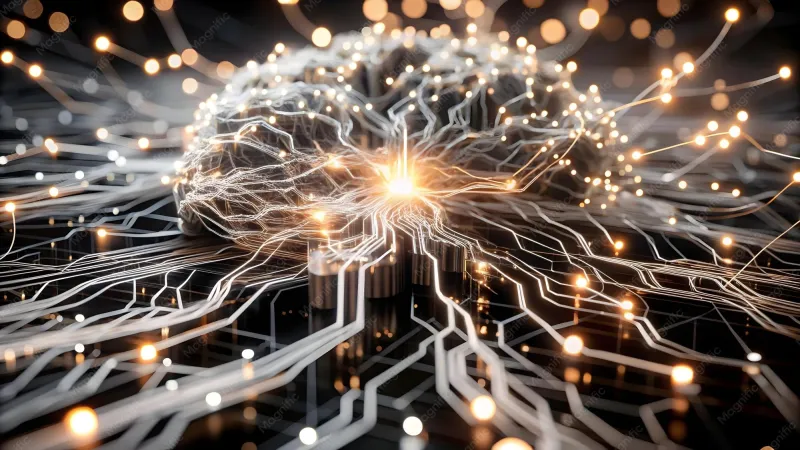
Photo: AI neural network abstract digital data visualization glowing, via img.freepik.com
There's a particular texture to a photo taken on a 2009 Samsung point-and-shoot in a suburban kitchen at Thanksgiving. You know the one. Slightly blown-out overhead lighting, the faint digital noise in the shadows, someone's elbow entering the frame from the left. Nobody curated that image. Nobody thought it would matter. It got uploaded to Facebook, maybe Flickr, maybe both, and then it just... sat there. Waiting.
It didn't wait forever.
The Harvest Nobody Announced
Over the last decade or so, the organizations building the most powerful AI image generation systems quietly assembled some of the largest visual datasets in human history. LAION-5B — one of the most widely used training datasets — contains roughly five billion image-text pairs scraped from the open web. Five billion. That number is so large it stops meaning anything until you start thinking about what's actually inside it.
Personal photos. Screenshots of text messages. Yearbook pictures that got digitized and uploaded by well-meaning relatives. Ultrasound images shared in pregnancy forums. Candid shots from birthday parties, graduations, funerals. The visual detritus of American life, accumulated across two decades of social media, personal blogs, and forgotten hosting services — all of it scooped up by automated crawlers that didn't ask, didn't knock, and didn't leave a note.
The legal question of whether any of this constitutes theft is currently winding its way through multiple courtrooms and will probably keep lawyers employed for years. But the philosophical question is weirder and more immediate: what actually happens to a memory once a machine has consumed it?
Visual DNA and What It Produces
Here's where things get genuinely strange. When you prompt a modern image generation model to produce something — a family gathering, a childhood bedroom, a small-town diner at night — what comes back isn't invented from nothing. It's reconstructed from statistical patterns extracted from millions of real images that once belonged to real people's real lives.
Researchers have demonstrated that these models can, under certain conditions, reproduce near-exact copies of training images. But more interesting than the verbatim regurgitations are the almost reproductions — the outputs that feel uncanny because they're assembled from pieces of authentic human experience that nobody explicitly gave permission to donate.
The lighting in AI-generated bedrooms looks like real bedrooms because it is real bedrooms, averaged and recombined. The specific way an AI renders a grandmother's kitchen — the placement of things on counters, the quality of afternoon light through a window — that's not invention. That's memory, processed through math, and handed back to you slightly wrong.
Some researchers have started calling this phenomenon "latent nostalgia" — the way these models encode not just visual information but the emotional register of the contexts in which photographs were originally taken. You're not imagining it when an AI image feels vaguely like something you've seen before. You probably have.
The Consent Gap
What makes this particularly thorny in the American context is how thoroughly the platforms facilitated the collection. Every time a social media company updated its terms of service — buried in pages of legalese most users never read — the scope of what could be done with uploaded content quietly expanded. By the time large-scale AI training was even a concept most people were aware of, the pipeline from personal photo to training data was already well-established infrastructure.
Photographers and visual artists have been loudest about this, and understandably so — their professional work getting absorbed into systems that can now approximate their style on demand is a concrete economic harm. But the more diffuse injury belongs to everyone who ever uploaded a photo of their kid's first birthday, their backyard in autumn, their face on a good day.
Nobody signed up to contribute to a collective visual unconscious for machines to dream inside of. It just happened, the way a lot of things on the internet just happened, in the gap between what was technically possible and what anyone thought to prohibit.
Ask It to Dream, Watch What Surfaces
The genuinely unsettling experiment — and one that's easy to run yourself — is to prompt these systems with something hyper-specific and American and domestic. A garage sale in the Midwest on a Saturday morning. A high school gymnasium decorated for prom in the early 2000s. A strip mall parking lot at dusk.
What comes back is almost always right in a way that's hard to account for purely through technical description. The details are too specific. The atmosphere too precisely calibrated. These models have absorbed not just images but the emotional grammar of American life as it was photographed by the people living it — casually, without artistic intent, in the moments that felt unremarkable at the time.
That specificity is the tell. Generic stock photography doesn't carry that weight. These outputs do because they were built from something real, something personal, something that belonged to someone.
What Gets Lost in the Averaging
There's a counterargument worth taking seriously, which is that all human art is built on influence and absorption. Painters learned by studying other painters. Writers internalized the cadences of everything they read. The line between influence and theft has never been perfectly clean.
But there's a meaningful difference between a human artist absorbing influences over a lifetime of deliberate engagement and a model processing five billion images in a data center over a few weeks. Scale changes the ethics of the thing. Consent changes the ethics of the thing. The fact that the people whose visual memories constitute the training data will never see a cent, never know their contribution, and never had a real choice in the matter — that changes the ethics of the thing.
What these systems dream when they generate images isn't neutral. It's our collective visual memory, stripped of the people who made it, compressed into weights and parameters, and redistributed as a commercial product.
The Signal Coming Back
MPAEGM has always been interested in what the digital void sends back when you listen carefully. This is one of those signals. Somewhere in the statistical heart of every major image generation model, there are fragments — unrecoverable and unattributable — of millions of private American moments. Thanksgiving dinners. Kids on Christmas morning. Somebody's backyard in July.
The machine ate all of it. Now it dreams.
And when you ask it to show you something that feels like home, it reaches into that archive of absorbed experience and gives you something back that's almost right. Almost familiar. Almost yours.
Almost.